





Tuesday
May192026
« “I Came to See That God Exists.” Interview with Priest Sergei Sokolovsky of the Diocese of Sourozh »
 19-05-2026
 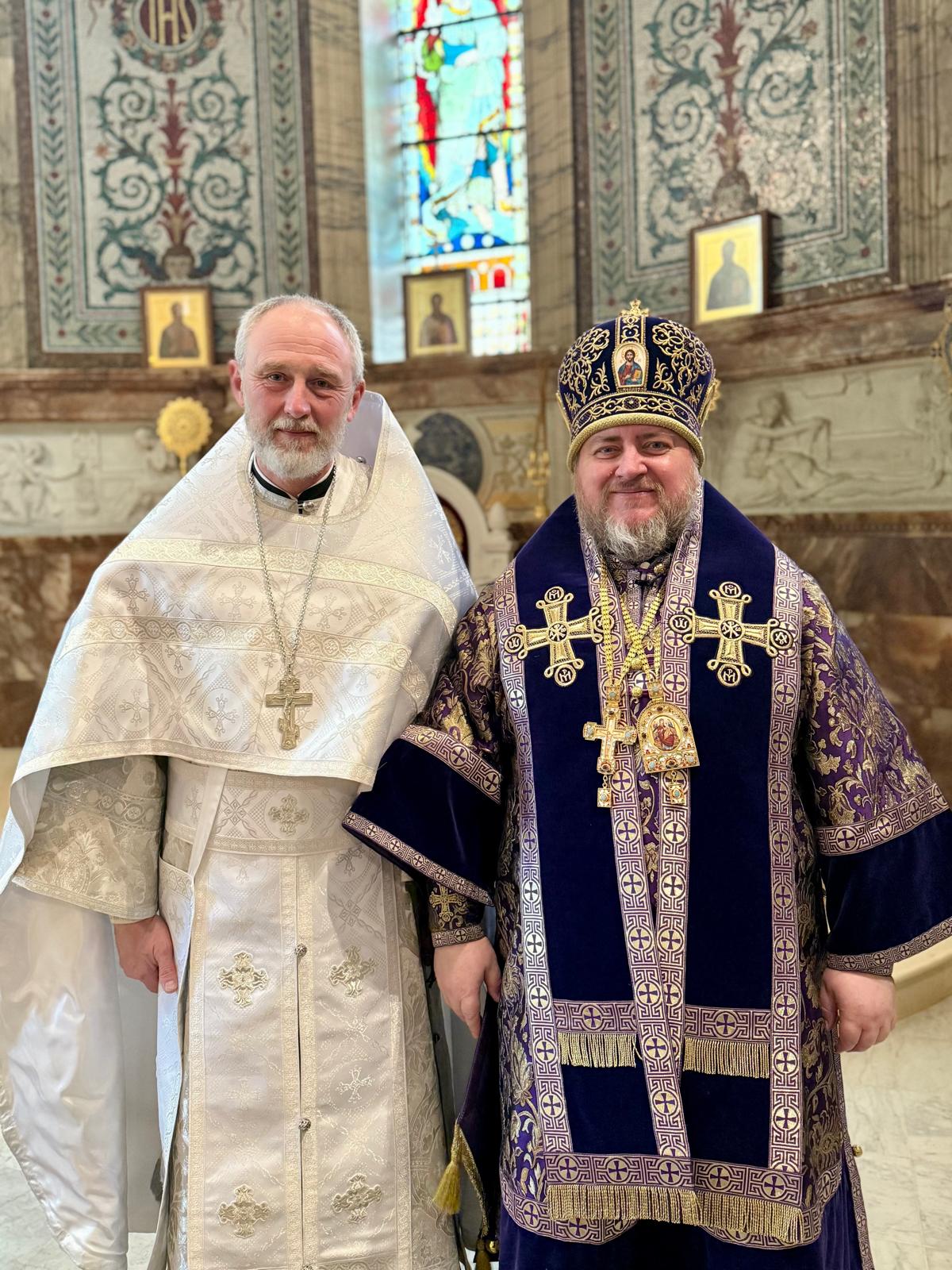 It took 26 years before Sergei Sokolovsky, a biologist from Minsk, became a priest in Birmingham. He went to the United Kingdom for three years to learn new research methods, but instead found his vocation there. Each time he returns to Minsk, Father Sergei, a cleric of the Diocese of Sourozh—the overseas diocese of the Russian Orthodox Church in Great Britain and Ireland—visits Father Andrei Lemeshonok. In the early 1990s, a meeting with the spiritual father of our monastery, then a priest at the Saints Peter and Paul Cathedral, became one of the most important events in the scientist’s life. Priest Sergei Sokolovsky spoke to our website’s correspondent about the remarkable coincidences on his path to the priesthood.
— My wife Larisa and I live in Birmingham. I sometimes serve at the Cathedral of the Dormition of the Most Holy Theotokos in London, the one acquired by Bishop Anthony of Sourozh. But in general, I am a cleric of the parish dedicated to All Saints who have shone forth in the British and Irish lands. Our rector is Archpriest Father Mikhail Gogolev, a descendant of first-wave Russian emigrants.
We have about 40 regular parishioners. On feast days, of course, more people come. Our community does not have its own church building. We hold services in the Church of Saint Agatha the Martyr of Sicily, where we permanently rent the right aisle. Before that, we rented premises from the Catholic Oratory, founded in Great Britain by Cardinal Henry Newman. A monastery used to be located there.
“A Beautiful Created World Was Revealed to Me”
— I studied at the Faculty of Biology at Belarusian State University. A beautiful created world was revealed to me: despite the fierce competition among species of animals and plants, it seemed to me there were no contradictions—it was beautiful in its complexity and diversity. But I was always interested in the origin of life: when did life arise on the planet? Darwin, having discovered the mechanisms of change in existing species, did not explain how humans appeared. All the arguments of progressivists and evolutionists about monkeys as our ancestors do not withstand criticism, nor do Oparin’s ideas about the primordial soup.
After graduating , I entered postgraduate studies. An acquaintance gave me a brochure about UFOs written by a Lutheran priest. The author drew a direct parallel with demonic influences on humans described as far back as the Middle Ages. I came to see that God exists, and that man is His creation. For a year I read spiritual literature, searching for God.
“Sergei, are you a believer?” a colleague once asked me. “Isn’t it time you chose a Church?”
When I was six months old, my grandmother had me baptized in a Catholic church. But my personal choice was connected with the striving of my heart in adulthood.
In 1991, I came to the Saints Peter and Paul Cathedral, where Father Andrei Lemeshonok served. We spoke, and he blessed me for Chrismation. That is how I entered Orthodoxy.
Now, whenever I am in Minsk, I go to Saint Elisabeth Monastery. Sometimes I serve there.
When you acquire faith, the Lord changes your way of thinking so radically that you can no longer live otherwise.
Science and Faith
— After defending my PhD in biophysics and photobiology, I worked at the National Academy of Sciences of Belarus. In 2000, I decided to go for an internship at the University of York to learn new research methods. My wife Larisa and our child joined me a little later. On the way, a miracle happened to them. My wife forgot to get my permission for our daughter to travel—this only became clear at the border. They were supposed to turn back, but the border guards showed understanding and let them through.
Later, there were many such “coincidences,” when life unfolded in an astonishing way toward service in the Church.
I worked at the University of Glasgow in Scotland and gained invaluable experience in molecular genetics and plant electrophysiology.
From the first day after moving (I don’t know why), I searched for an Orthodox parish and a way to become fully involved in church life: regular services and prayer. This happened at Saint Nicholas Parish in Dunblane, a town near Glasgow. It is an English-speaking community whose rector was the late Priest Alexander Williams. That is where my church service began—and completely unexpectedly.
Once, before a service, it turned out the parish altar server was ill, and Father Alexander asked me to assist at the Divine Liturgy. I realised I needed to hand him something during the service (my spoken English was still poor), and I agreed. When he blessed me and called me into the altar, I was shocked—but it was too late to refuse.
My contract was ending; three months remained. My family had already returned home, and I planned to go back to Belarus, where a job awaited me.
Suddenly I learned that I was no longer being offered that position in Minsk. At the same time, a fire broke out at the University of Glasgow, destroying our building along with all the research from our grant. The university offered me a new two-year contract to restore everything.
In Glasgow, we began creating a Russian Orthodox community. With the blessing of the priest overseeing us, I was elected head of the parish council and served in the altar. There, together with my wife Larisa and other parishioners, we opened a Russian Orthodox school at the parish of Saint Kentigern of Strathclyde, and I was appointed its director.
Following a tradition going back to the missionary work of Metropolitan Anthony (Bloom), we accepted all who agreed with the school’s rules and program, whose main subjects were the Law of God, Russian language, culture, and history. My wife taught history.
I met my future wife in our first year at university—we studied in the same faculty. After graduation, she worked at a young naturalists’ station. Notably, there were New Martyrs in her family line.
In 2007, after signing a contract with the University of Dundee, I moved into medical biophysics, biophotonics, and laser-based methods of treatment and diagnostics. At the same time, with the blessing of Archbishop Elisey of Sourozh, I enrolled in the Saint Sergius Orthodox Theological Institute in Paris, graduating with a licentiate degree in theology. Later, the institute came under the Archdiocese of the Russian Orthodox Church in Western Europe, under the omophorion of Patriarch Kirill of Moscow.
In 2015, I was ordained a deacon. We lived in Scotland for 16 years, then moved to Birmingham, where we became members of the parish of All Saints who have shone forth in the British and Irish lands.Whenever you move in Britain, one major concern for parents is finding a good school for their children. We searched in Birmingham and nearby areas, but all attempts failed. Our youngest daughter faced the serious risk of having no school place for the entire academic year. In the city center there is a church dedicated to Saint Chad (a saint of the undivided Church of the 7th century), where his relics are kept. With the blessing of our bishop, we prayed there and, entrusting everything to God’s will, went on holiday.
When we returned, we found a letter offering our daughter a place, even though the school was full. It was the Catholic Saint Paul’s School, within walking distance of where I serve.
Our ruling bishop, Matthew of Sourozh, while serving as dean of Scotland and Northern England, organized the first pilgrimages to British saints. He instilled this love in us as well. Now, thanks to the clergy of our diocese, such pilgrimages have become regular.
For example, we serve molebens at Saint Winefride’s well in Wales, where people can immerse themselves in the waters; this inspires believers, and they receive healing.
Wales has many early Christian shrines, and it is encouraging that local people know and venerate their ancient saints.
“An Elder Said I Would Be Ordained”
— Even before my studies in Paris, my wife once met an elder from Chuvashia in Moscow, Archimandrite Jerome (Shurygin), now deceased, abbot of the Holy Trinity Monastery in Alatyr. He said that I would be ordained. Recently, during Great Lent—on the week of Saint John Climacus and the feast of the Forty Martyrs of Sebaste—Bishop Matthew of Sourozh ordained me to the priesthood.
I never thought about becoming a priest, but after being offered the possibility in 2005, and after much reflection and prayer to Saint Sergius of Radonezh, it became clear that I could not refuse. I was guided by faith in God and His holy will.
Having found faith in 1989 and decided to join the Holy Catholic and Apostolic Church, for all these 37 years I have been led by the Lord through the desert of my soul.
From experience, I have often been convinced that all obediences are equal before God; what matters is fulfilling them with humility and love. Only in this way does a person draw near to the Kingdom of Heaven (see Matthew 4:17). One needs only to observe carefully what happens in one’s life and not resist God’s will.
A fellow student of ours, Veronika, whom we once met in the London cathedral, introduced me in absentia to Archpriest Vladimir Tsvetkov from Saint Sophrony’s Hermitage, a spiritual child of Father John Krestyankin. Father Vladimir agreed to guide me spiritually. He also passed on Father John’s words: “God’s will should be accepted with discernment and counsel.” I tried to follow this throughout my years after coming to faith.
“The Lord Awaits a Person’s Coming to His Church”
— I tell parishioners: “Do not forget that you are chosen. The blood of the Lord was shed for the sins of the whole world, but you became chosen because you chose Christ. Our path is long, as Saint Sophrony of Essex said. Anyone who accepts God’s will and reflects on their life will see that every person who chooses Christ and comes to the Orthodox Church receives the gift of the Spirit given in Chrismation. This seed must bear the fruit of faith. Each person’s fruit is different, but all who bring to Christ the fruits of service—great or small—attain the Kingdom.”
A kind and compassionate priest is a help to people in life. Therefore, our calling is to help people. These words were given to me on the day of my ordination by one of the oldest clerics of our diocese, Archimandrite Daniel. The need for spiritual help in Great Britain is immense; many young English people are now seeking the Truth and finding it in the Orthodox Church.
Paradoxically, I went abroad to learn new scientific methods but found life in the Church. Sometimes one must “cut the cord” tying them to their former life, and then remarkable events begin to unfold.
The circumstances of my life built upon one another and formed me as a Christian: I was a parish warden, a Sunday school director, served as a reader, then a deacon, and now a priest.
As a schoolboy, I once dreamed of being immortal, which is why I chose to study biology. At the time, I thought this knowledge would lead humanity to immortality. God heard me and gave true immortality—in Jesus Christ, our Savior.
Prepared by Olga Kosyakova
Obitel-minsk.ru/Sourozh.org